How and Why We Built TableGo for Modern UK Restaurants
by Compera Ltd, Digital Agency
At Compera, we have spent years working alongside hospitality businesses — designing websites, building booking flows, and helping restaurants present themselves properly online. Through that work, we kept hearing the same frustrations from owners and operators across the UK. The tools they relied on were either too expensive, too rigid, or simply not built with their day-to-day reality in mind.
That is the short version of why we built TableGo. The longer version is worth telling, because it says something about where restaurant technology is heading — and what modern operators actually need to stay competitive.
The Problems We Kept Seeing in Hospitality
Restaurants are not short of software options. But having options and having the right option are two very different things. Over the course of dozens of hospitality projects, we noticed the same set of issues coming up repeatedly.
Per-cover fees that scale against you. Many booking platforms charge restaurants for every seated diner. That model punishes growth. A busy weekend should be a win, not a billing event.
No-shows eating into margins. The industry-wide no-show rate in the UK sits somewhere between 12% and 20%, depending on who you ask. For a 40-cover restaurant, even a handful of no-shows on a Friday night can wipe out the evening's profit. Most systems either ignore the problem or offer clunky workarounds.
Fragmented guest data. One system handles bookings. Another handles email marketing. A third tracks walk-ins on paper. The result is that restaurants have no clear picture of who their guests are, how often they visit, or what they tend to order. That is a massive missed opportunity.
Limited table management. Plenty of booking tools let diners reserve a time slot, but very few give restaurant teams real control over floor plans, table assignments, and live service flow. That gap forces staff to manage logistics in their heads or on whiteboards, which falls apart during busy periods.
No consumer-facing presence. Most restaurant software focuses entirely on the back office. But diners also need a way to discover, browse, and book restaurants without friction. When those two sides are disconnected, everyone loses.
Why Existing Solutions Were Not Enough
We looked hard at the existing landscape before deciding to build something new. The major platforms do certain things well — they have scale, brand recognition, and large diner networks. But they also come with trade-offs that many independent and small-group restaurants cannot afford to accept.
The per-cover pricing model is the most obvious issue, but it is not the only one. Many platforms prioritise their own marketplace over the restaurant's brand. Diners book through the platform, not through the restaurant — which means the platform owns the relationship. Over time, that erodes the restaurant's direct connection with its guests.
We also found that the feature sets of most existing tools were either too narrow or too bloated. Smaller operators do not need an enterprise-grade system with 200 features they will never touch. They need bookings, table management, guest records, and a way to reduce no-shows — all in one place, without a steep learning curve or a painful monthly bill.
That gap between what existed and what was actually needed is where TableGo started to take shape.
Why We Built TableGo
TableGo was not a side project or a speculative experiment. It came directly from client work. We had already built custom booking components, reservation logic, and guest-facing interfaces for several hospitality clients. At a certain point, it made more sense to build a standalone product than to keep rebuilding the same functionality from scratch.
We set out to create restaurant reservation software for UK restaurants that solved the specific pain points we had documented over years of agency work. The goals were clear from the start:
- No per-cover fees. Restaurants pay a flat, predictable rate. A full house on a Saturday night should not cost more than a quiet Tuesday.
- Deposit and prepayment support. Give restaurants real tools to fight no-shows, not just reminder emails that get ignored.
- Proper table management. Visual floor plans, drag-and-drop table assignments, and live status tracking so front-of-house teams can manage service properly.
- Built-in guest CRM. Every booking, every visit, every preference — captured automatically and available to the team without exporting CSVs or logging into a separate platform.
- A consumer-facing side. Diners should be able to find and book restaurants directly, not just through the restaurant's own website.
We wanted to build a restaurant booking system that felt modern, worked on mobile, and respected both sides of the equation — the restaurant's need for operational control and the diner's expectation of a smooth booking experience.
Two Sides of the Platform
One of the early design decisions that shaped TableGo was the separation between the business platform and the consumer platform. These are two distinct but connected experiences.
For Restaurant Owners
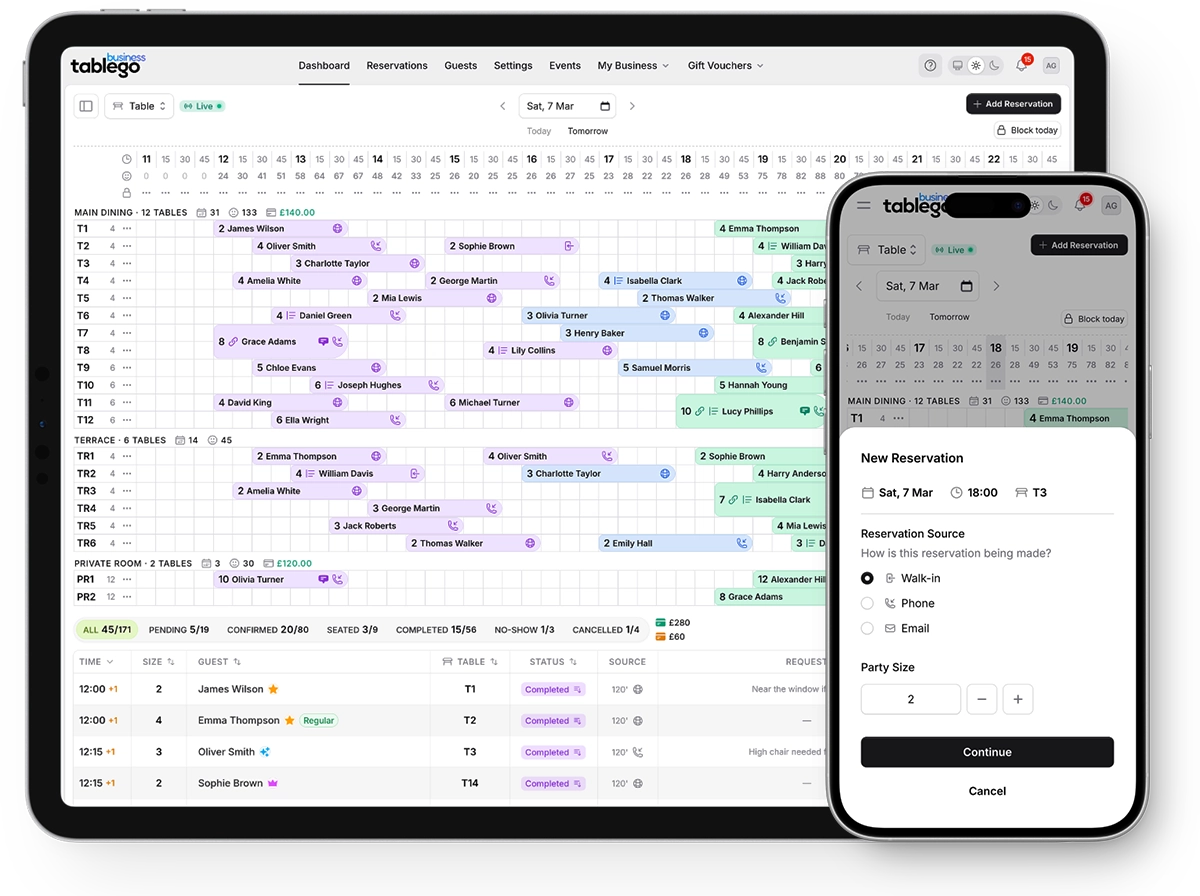
The business side of TableGo — available at business.tablego.uk — is the operational hub. This is where restaurant owners and managers handle everything from incoming bookings and floor plans to guest records and events.
Key capabilities on the business side include:
- Direct online bookings with real-time availability, so guests can book without phoning.
- Deposit collection at the point of booking, which has a measurable impact on reducing no-shows.
- Table management software with visual layouts that reflect the actual restaurant floor, not just a list of time slots.
- Guest CRM that builds a profile for every diner over time — visit history, preferences, dietary notes, spend patterns.
- Gift vouchers that restaurants can sell directly, generating revenue upfront and driving return visits.
- Events management for prix fixe evenings, tasting menus, private dining, and seasonal promotions.
The emphasis throughout is on giving restaurant teams control without complexity. The interface is clean, mobile-friendly, and designed for people who are running a service — not sitting at a desk.
For Diners
The consumer side — tablego.uk — functions as a consumer restaurant discovery and booking platform. Diners can browse restaurants by location, cuisine, or availability and book a table directly. No account required for a basic booking. No redirects to third-party sites.
This matters because direct restaurant bookings benefit everyone. The restaurant keeps the relationship. The diner gets a faster, simpler experience. And because the consumer platform is connected to the same back-end as the business tools, availability is always accurate and confirmations are instant.
Over time, the consumer side will grow into a genuine discovery tool — helping diners find new restaurants, browse menus, and book with confidence. For restaurants, being listed on TableGo means gaining visibility without giving up control or paying per cover.
What Makes Modern Restaurant Software Different
The hospitality software UK market has changed significantly in the past few years. Operators are no longer willing to accept tools that were designed in 2010 and never meaningfully updated. The expectations are higher now, and rightly so.
Modern table management software needs to do more than accept reservations. It needs to:
- Integrate bookings with floor management. Knowing that a table is booked is not enough. Staff need to see where that booking sits on the floor, how long the previous party has been seated, and whether a table turn is on track.
- Capture data automatically. A restaurant that seats 100 covers a night generates valuable data — if the system captures it. Guest preferences, visit frequency, average spend, and feedback should all flow into a CRM without manual entry.
- Support multiple revenue channels. Bookings are one revenue stream. Gift vouchers, event tickets, and prepaid experiences are others. A modern booking platform for restaurants should handle all of them in one place.
- Work on any device. Front-of-house staff are not standing behind a desktop. The system needs to work on a tablet at the host stand, on a phone in the kitchen, and on a laptop in the back office.
TableGo was designed with all of this in mind. We did not retrofit features onto a legacy platform. We built from the ground up, using modern web technology, with input from real restaurant operators at every stage.
Why This Matters for UK Restaurants Now
The UK hospitality sector is under genuine pressure. Rising costs, staffing challenges, and shifting consumer behaviour mean that margins are tighter than they have been in years. In that environment, the tools a restaurant uses are not just operational — they are strategic.
A restaurant that relies on a booking system charging per cover is effectively taxing its own growth. A restaurant with no way to collect deposits is absorbing no-show losses that could be prevented. A restaurant without a CRM is missing chances to bring guests back — which is far cheaper than acquiring new ones.
Hospitality software is no longer a back-office concern. It is part of how a restaurant competes. The operators who invest in the right tools now — tools that reduce friction, protect revenue, and build guest loyalty — will be the ones still thriving in five years.
That is the conviction behind TableGo. Not just that better software is possible, but that it is necessary.
Frequently Asked Questions
What is TableGo?
TableGo is a restaurant reservation and table management platform built by Compera. It has two connected sides: a business platform for restaurant owners (business.tablego.uk) and a consumer platform where diners can discover and book restaurants (tablego.uk).
Does TableGo charge per cover?
No. TableGo uses flat-rate pricing. Restaurants are not charged per seated diner, which means costs stay predictable regardless of how busy the restaurant gets.
How does TableGo help reduce no-shows?
TableGo allows restaurants to collect deposits or prepayments at the point of booking. This has been shown to significantly reduce no-show rates compared to systems that rely solely on email or SMS reminders.
Is TableGo only for large restaurants?
Not at all. TableGo is designed to work for independent restaurants, small groups, and neighbourhood spots — not just high-volume operations. The interface is straightforward enough for a small team to use without dedicated training.
Can diners book without creating an account?
Yes. The consumer booking experience on tablego.uk is designed to be as frictionless as possible. Diners can book a table without needing to register.
Who built TableGo?
TableGo was built by Compera, a UK-based digital agency that specialises in web design, development, and digital products for businesses across multiple sectors — including hospitality.
Final Thoughts
TableGo exists because we saw the same problems too many times and decided to solve them properly. It is not a template product or a white-label reskin. It is a purpose-built booking platform for restaurants, shaped by real operator feedback and years of hands-on work in the hospitality space.
If you run a restaurant and you are tired of overpaying for a system that does not quite fit, or if you are still managing bookings by phone and scribbling on a diary, TableGo is worth a look. Visit business.tablego.uk to see how it works, or get in touch with our team to talk about what your restaurant needs.